
PHP vs Python: Which Has More CVEs in 2026? A Data-Driven Comparison
PHP and Python are the two most widely deployed server-side languages in web development. EOLCanary tracks both across all active and EOL versions. Here is what the data shows when you put them side by side.
Total CVE counts
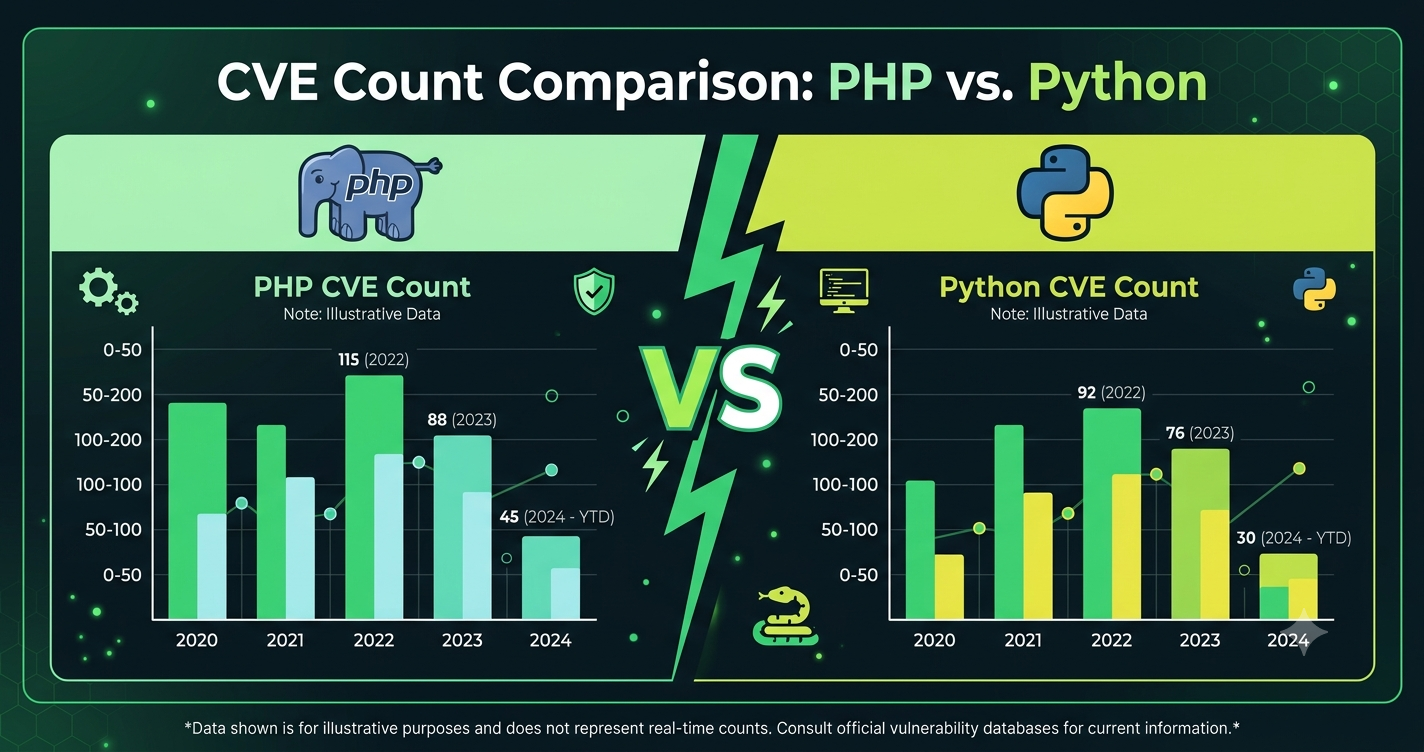
Across all tracked versions, PHP carries significantly more CVEs than Python in EOLCanary's database. This reflects PHP's historically larger attack surface as a web-first language with more parsing, more string handling, and more exposure to untrusted input.
Python's CVE profile is smaller in volume but the severity distribution tells a different story: Python CVEs tend toward higher CVSS scores on average, with several Critical-rated vulnerabilities in the 3.x line related to pickle deserialization.
Version-by-version breakdown
PHP 7.x versions are the most CVE-affected branches. PHP 7.4 reached EOL in November 2022 carrying 31 CVEs — many permanently unpatched. Python 3.8 and 3.9 are the most affected Python versions, with Python 3.8 reaching EOL in October 2024 with 12 tracked CVEs.
Patch response time
Both the PHP and Python security teams release patches within 7–14 days of CVE disclosure for supported versions. For both languages, the critical variable is not patch speed — it is whether your version is still receiving patches at all.
CISA KEV appearances
PHP has more entries on the CISA KEV list than Python, reflecting both higher CVE volume and PHP's prevalence in web-facing applications targeted by opportunistic attackers. PHP CVEs related to file upload handling and type juggling have been the most exploited categories.
What this means for your stack
The security posture of both languages is almost entirely determined by one factor: whether your version is still receiving patches. PHP 8.2+ and Python 3.11+ are the minimum versions with active security support as of mid-2026.
Track CVEs on EOLCanary: PHP EOL page | Python EOL page.