
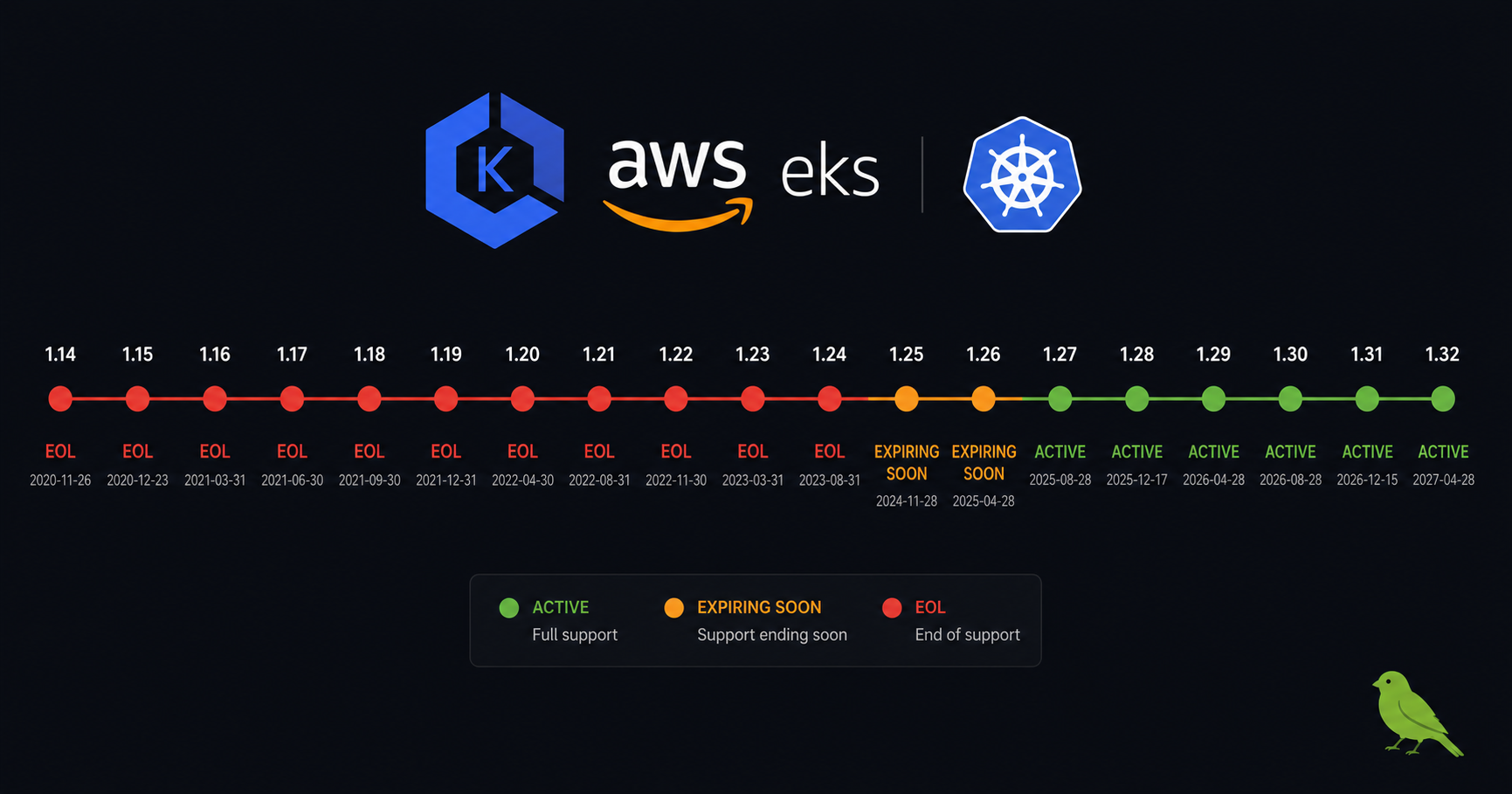
AWS EKS Complete EOL Calendar: Every Version, Every Date (2018–2026)
AWS Elastic Kubernetes Service follows a support lifecycle that most teams discover too late: each minor version is supported for approximately 14 months, after which AWS begins force-migrating clusters with as little as 60 days notice.
How EKS versioning works
EKS follows upstream Kubernetes versioning on a slightly delayed schedule. AWS typically adds support for a new Kubernetes minor version 2–3 months after the upstream release. Support ends approximately 14 months after AWS introduces the version — not 14 months after the upstream release date.
The force-upgrade policy
When an EKS version reaches end of support, AWS actively begins migrating clusters that have not upgraded. AWS sends notifications 60 days before the EOL date, then 30 days before, then performs the upgrade automatically. Unplanned Kubernetes upgrades in production are among the highest-risk maintenance events a platform team can face.
Current EKS versions and their EOL dates
As of June 2026, EKS 1.29 and earlier have reached end of support. EKS 1.30 support ends in late 2026. Teams should be actively running 1.31 or targeting 1.32, which has the longest remaining support window.
Why EKS CVEs are underreported
CVEs affecting EKS are often filed against upstream Kubernetes components rather than Amazon EKS directly. Teams searching NVD for "EKS CVE" miss the majority of vulnerabilities affecting their clusters. The correct approach is to track CVEs against the Kubernetes version running inside EKS — which EOLCanary does by mapping EKS versions to their underlying components.
Planning your EKS upgrade cadence
EKS clusters require at least one minor version upgrade per year to stay within the support window. Building a quarterly upgrade review into the platform team calendar is the minimum viable process for avoiding forced migration.
Monitor your EKS version on the Amazon EKS EOL page on EOLCanary.